

You have the data. You have the people. What’s missing is the layer that connects them.
Every college and university has data. Lots of it. Enrollment numbers, retention rates, financial aid disbursements, course completion metrics, HR records, budget actuals, student engagement scores. It lives in your SIS, your LMS, your finance system, your HR platform, and probably a dozen spreadsheets that someone built five years ago and everyone still relies on.
The data isn’t the problem. The problem is what happens between the data and the decisions.
At most institutions, that space is filled with manual processes. Someone pulls a report. Someone else reformats it. A third person builds a presentation around it. A fourth person asks a follow-up question that requires starting the whole cycle over. By the time the information reaches the person making the decision, it’s late, it’s static, and it might already be outdated.
That’s not a data strategy. That’s a data relay race.
This article is about what it looks like when an institution moves beyond that model and into something that actually works at scale.
What “data strategy” actually means on a campus.
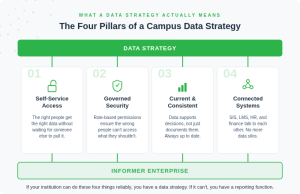
Let’s strip away the buzzwords. A data strategy doesn’t mean you need a Chief Data Officer, a governance committee, or a 40-page framework document. Those things might come later. But at its core, a data strategy means four things:
- The right people can access the right data without waiting for someone else to get it for them.
- The wrong people can’t. Access is governed by roles, permissions, and policies that reflect your institutional structure and compliance obligations, from FERPA to state privacy laws.
- The data is current, consistent, and presented in a way that supports decisions, not just documents them.
- The systems that hold your data are connected, not siloed.
That’s it. If your institution can do those four things reliably, you have a functioning data strategy. If it can’t, you have a reporting function. There’s a meaningful difference between the two.
The shift from reactive to proactive.
Most campus reporting is reactive. Someone asks a question, and the IR office or IT team goes and finds the answer. The work is driven by requests, not by strategy.
In a proactive model, the answers are already available before anyone has to ask. Enrollment dashboards update automatically. Retention indicators are visible in real time. Budget status is always current. When the provost wants to know how fall enrollment is shaping up, the answer isn’t “let me pull that for you.” It’s “here’s the dashboard, and here’s what’s changed since last week.”
This shift doesn’t happen because people work harder. It happens because the tooling supports it. Specifically, it requires:
- Self-service dashboards that department heads, deans, and VPs can access and filter on their own. Not simplified views that hide the real data. Actual interactive dashboards with the ability to drill into details.
- System integration that pulls data from your SIS, LMS, HR, and finance platforms into a single reporting layer automatically, with role-based permissions that ensure each user only sees what they’re authorized to see. No manual exports, no reconciliation spreadsheets, no “I’ll have that for you by Thursday.”
- Automated delivery and alerts so the right people see the right information at the right time without having to go looking for it.
- AI-assisted analysis that doesn’t just display data but helps interpret it. Spotting trends, flagging anomalies, and surfacing the story inside the numbers so your analysts can focus on the “what’s next” instead of the “what happened.”
What this looks like in practice.
Let’s walk through a few real scenarios where this shift plays out on a campus.
Enrollment management. Your admissions team is tracking applications, admits, deposits, and yield rates across programs, regions, and demographics. In a reactive model, someone runs weekly reports and distributes them via email. In a proactive model, the enrollment dashboard is live, filterable, and accessible on any device. The VP of Enrollment checks it from her phone between campus tours. When deposits in a specific program dip below the target threshold, an alert fires automatically. The team responds in days, not weeks.
Student success and retention. Your student success office is trying to identify at-risk students before they disappear. That requires combining SIS data (enrollment status, GPA) with LMS data (login frequency, assignment completion) and possibly financial aid data (unmet need, disbursement gaps). In a siloed reporting model, building that picture means pulling exports from three systems and manually merging them. With connected systems and full API access, that composite view is a dashboard that updates itself. Early alert indicators are built into the data layer, not into someone’s memory. And because permissions are role-based, advisors see their assigned students while institutional leadership sees the aggregate picture. The data is open where it should be and protected where it has to be.
Accreditation and compliance. Your institution is preparing for a regional accreditation visit. The documentation requirements span academics, finance, student outcomes, and institutional effectiveness. In a reactive model, this is a six-month fire drill of pulling data, formatting reports, and assembling binders. In a proactive model, the data that feeds accreditation requirements lives in dashboards and branded templates that are maintained year-round. When the visit approaches, you’re curating, not scrambling.
Board reporting. Your president needs a quarterly update for the Board of Trustees. It should include enrollment trends, financial position, student success metrics, and strategic initiative progress. In a reactive model, this is a multi-week production involving multiple offices, multiple formats, and multiple rounds of revision. In a proactive model, the board report is a dashboard with templated exports that pull live data. The president’s office can generate it in minutes, and it looks the same every time because the templates enforce consistency.
Finance and budget modeling. Your CFO is trying to project the revenue impact of a 3% enrollment decline in a specific program. In a reactive model, that analysis lives in someone’s personal spreadsheet. In a proactive model, budget and enrollment data are connected, and scenario modeling is built into the reporting layer. The CFO can adjust assumptions and see the impact immediately, without waiting for someone to rebuild a spreadsheet.
The role of AI in campus analytics.
AI in higher ed reporting isn’t about replacing analysts. It’s about removing the tedious parts of their work so they can focus on interpretation, strategy, and then act – faster.
When an IR director spends two hours deciding how to visualize a dataset and formatting the output, that’s two hours not spent analyzing what the data means. AI-powered visualizations handle the formatting decisions automatically, selecting the right chart type based on the data structure and highlighting the patterns that matter.
AI-generated reports take it further by combining multiple datasets into a single narrative summary. Instead of building a retention report from scratch every semester, the system synthesizes enrollment, academic performance, financial aid, and engagement data into a cohesive overview. The analyst reviews and refines it instead of assembling it from raw materials.
This is especially powerful for smaller IR offices, and that’s most of them in higher ed. When you have two or three people serving the data needs of an entire institution, anything that compresses the time between question and answer is a force multiplier.
Why this matters right now.
Higher ed is facing a convergence of pressures that make the shift from reporting to strategy more urgent than it’s been in the past.
The enrollment cliff is real. Institutions that can see shifts early and respond quickly will have an advantage over those still relying on end-of-cycle reports. Real-time enrollment data isn’t a luxury. It’s a competitive necessity.
Accreditation standards are getting more data-intensive. Regional accreditors increasingly expect institutions to demonstrate continuous improvement with evidence, not just compliance snapshots. Year-round data visibility makes that expectation manageable instead of overwhelming.
Leadership expectations have shifted. Presidents, provosts, and boards have seen what real-time dashboards look like in other industries. They’re no longer satisfied with monthly PDF reports. They want to interact with data, ask follow-up questions on the fly, and access it from wherever they are. But expanding that access has to come with guardrails. Role-based permissions that travel with the data, whether it’s viewed on a desktop, a tablet, or a phone, are what make self-service viable without creating a FERPA liability.
Budget scrutiny is increasing. State legislatures, governing boards, and families are all asking harder questions about where money goes and what outcomes it produces. Institutions that can answer those questions clearly and quickly build trust. Those that can’t are left playing defense.
Building the foundation.
Moving from reports to a data strategy doesn’t happen overnight, and it doesn’t have to. Most institutions start with one high-visibility use case, enrollment dashboards, board reporting, or accreditation prep, and expand from there.
The key is having a platform that supports the full journey. Not just pulling data, but connecting systems, building interactive dashboards, enforcing brand consistency through templates, leveraging AI to accelerate analysis, and making everything accessible on any device.
That’s what Informer Enterprise was designed to do. It’s not a bolt-on to your existing reporting setup. It’s the foundation for the kind of data culture that modern institutions need to operate, compete, and serve their students well.
If you’re ready to move beyond reports and build a real data strategy for your campus, we’d like to help.
Let’s start a conversation about where you are today, where you want to be, and how Enterprise can bridge that gap.
This is Part 3 of our “Beyond Reports” series for higher ed.
Previously: “7 Signs You’ve Outgrown Standard Reporting“ and “5 Things Your Campus Reporting Tool Should Do That It Probably Doesn’t“
Next up: “Building Your Case for Enterprise BI: A Budget Justification Guide for Higher Ed.“